
Searching Coleman County Criminal Dockets
Sort the case into one of three levels before anything else. Felonies and other district-level prosecutions go through the 42nd District Court, and its District Clerk holds those files. A misdemeanor charged at the county level belongs to Coleman County Court, with the County Clerk keeping the record. Class C complaints and traffic citations stay with the JP or the municipal court that issued them. Federal charges are different: PACER covers the Northern District of Texas, and no Coleman County clerk can pull those. No cause number? Give the clerk the full name as filed, a rough filing window, the offense level if known, and the court. Then work through a controlled search:
- Identify the likely Coleman County criminal court from the charging or citation document.
- Search re:SearchTX only as a participating-court layer, not a complete archive.
- Ask the District Clerk, County Clerk, JP, or city court to confirm the case and current setting.
- Match the court, cause number, charge category, filing date, and party before relying on an entry.
- Request the docket sheet or exact order if a short result does not answer the question.
Coleman's 42nd District Criminal Files
For felony files in the 42nd District Court, the District Clerk is the place to start. The OCA directory lists Darlene Huddle in that role. Her office is at 100 Liveoak Street, Suite 201, Coleman, Texas 76834-3533, phone 325-625-2568, email dclerk@co.coleman.tx.us. The 2025 directory also names District Judge Arimy Beasley, coordinator Darla Quinney, and reporter Teri Nichols. That division of labor matters. Some scheduling questions never touch the clerk counter at all.
A clerk can tell you whether a filing or setting appears and how to get copies. A coordinator works the calendar within court policy. Neither role makes re:SearchTX a full criminal system, and its own materials say as much, cautioning users against treating the platform as a complete criminal-record search.
Inside a Coleman County Criminal Docket
Think of a Coleman County criminal docket as a timeline, not a verdict. Read it by date and event, and pull the full filed document when exact wording matters. No official local source publishes one universal cause-number format, so copy the number exactly and never guess at a prefix.
| Charge or category | Identifies the general criminal classification; confirm exact language in the charging record. |
|---|---|
| Case or cause number | The strongest identifier for clerk confirmation. |
| Filing date | Marks the case opening, not every later event. |
| Hearing setting | May give date, time, court, and event type. |
| Motion or filing | Shows procedural activity, not that relief was granted. |
| Plea or disposition | Records an outcome entry; confirm its date and meaning. |
| Sentence or order | Points to court action; the signed document is controlling. |
| FTA or warrant notation | Requires prompt confirmation from the issuing court. |
Tracking your own case? Set each new entry beside the last order or notice you received. Portal labels stay brief and can lag behind the file.
County Misdemeanor Dates in Coleman
The official Coleman County Court page posts a misdemeanor docket usually held on the third or fourth Thursday of each month, plus annual dates. That word "usually" deserves attention. So does the page's subject-to-change warning. A posted pattern cannot replace the setting issued in your own Coleman County case.
Call the County Clerk at 325-625-2889 or the court itself to confirm. A reset, continuance, cancellation, plea setting, or later order can change what you first saw. The county lists a second-floor courtroom as the usual spot. But that says nothing about the day's list. It does not tell you whether your case is still on it.
Note: Treat the Thursday pattern as a calendar aid, and treat the clerk's or court's current answer as the real check on your case.
How a Criminal Case Moves
Not every case follows the same path. Still, a Coleman County docket usually traces a broad sequence, from early settings toward a result. Read each entry as one step, never as the final outcome.
Docket flow: Filing or complaint › arraignment or initial appearance › pretrial settings and motions › plea or trial › disposition › sentencing or closing entry.
An arraignment comes early. A pretrial setting may cover motions, plea talks, or readiness. Plea and trial are separate routes. Disposition records the result, with sentencing or a closing order possibly following. When a Coleman County docket lists a motion, check the later ruling before assuming what the court did.
Coleman County Class C Dockets
The countywide Justice of the Peace handles Class C criminal and traffic matters alongside civil work and magistrate duties. Its official Coleman County JP page asks that correspondence come in writing and posts forms for a plea, a deferral, and a driving-safety request. Mail works. So does email at justice@co.coleman.tx.us. Find the office at 100 W. Live Oak, Suite 103, or call 325-625-4223. There is no voicemail.
One caution: the court-linked GovRec screen is a payment route, not a public criminal docket search.
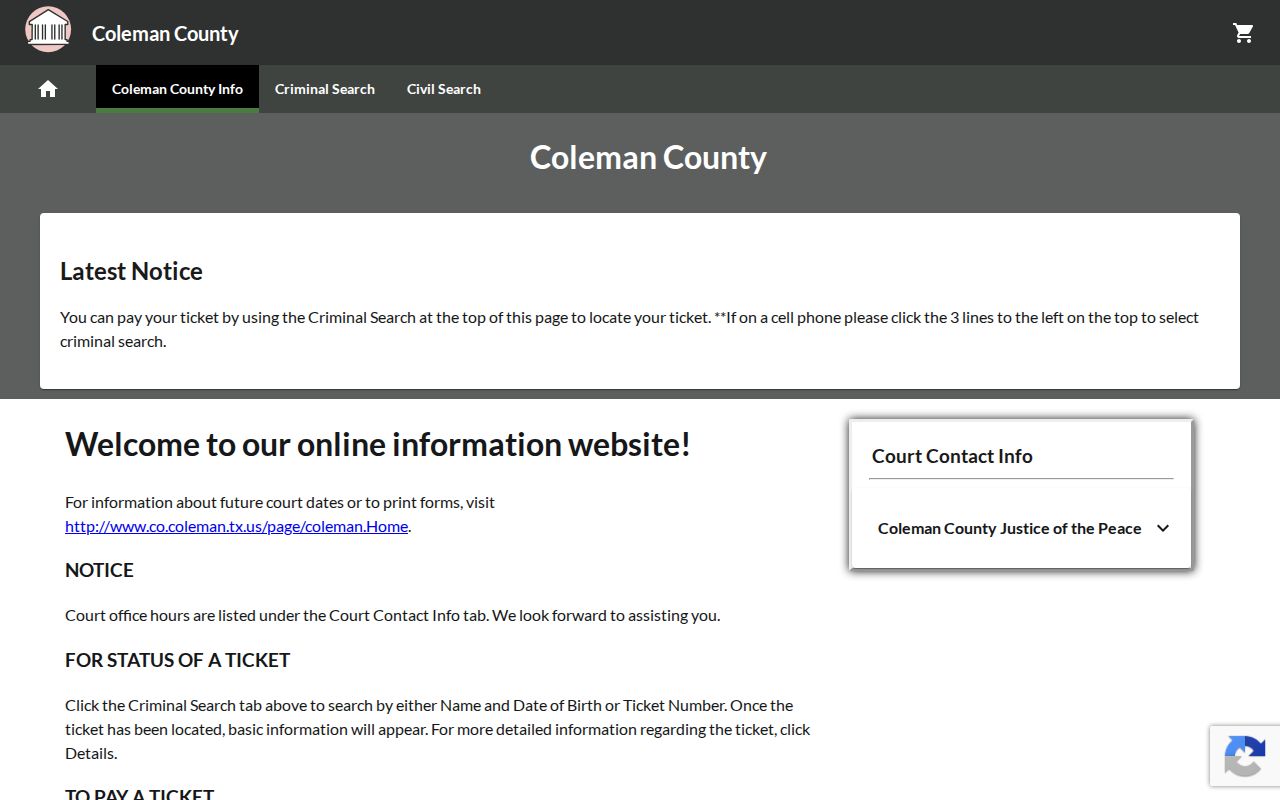
Want a not-guilty setting, a deferral, or a driving-safety option? Contact the JP before paying anything. The court treats full payment as a no-contest plea and conviction. A citation from Coleman or Santa Anna city court is different. It goes to that municipal court instead.
Courts That Hold Criminal Dockets
The split among courts decides both where you search and who keeps the record. It also keeps a city citation from getting tangled up with a felony file.
| Matter | Coleman County route | Record contact |
|---|---|---|
| District felony | 42nd District Court | District Clerk |
| County misdemeanor | Coleman County Court | County Clerk and County Court calendar |
| Class C or traffic | Countywide JP or city municipal court | Issuing court |
| State appeal | Eleventh Court of Appeals | TAMES appellate search |
| Federal offense | Northern District, San Angelo Division | PACER and federal clerk |
The appellate docket starts only after a notice of appeal, so it is not the live trial setting. TAMES refreshes nightly. Federal and state records stay separate.
Coleman Criminal Caseload Context
For context, the OCA fiscal year 2024 district activity report counted 193 active criminal cases at the start of the year for Coleman's district row. It also counted 21 reactivated and 125 added. Disposals came to 127. Another 32 were made inactive. The count of active cases stood at 189 at year end. These are administrative totals for one reporting year. They name no cases, show no calendar, and predict nothing about how long a prosecution takes.
Added and disposed totals only sketch the clerk's workload. They say nothing about how one Coleman County criminal docket moved or ended.
Sealed Dockets and Public Access
Not everything in a Coleman County criminal file is open. Juvenile matters can stay confidential. An expunction can strip criminal-history material away, and nondisclosure law can limit who spreads it. A sealing order or redaction may hide a document. A neutral docket entry can still stay public. For judicial case records, the Texas Public Information Act is not the simple route.
Access limits: Family Code Chapter 58 addresses juvenile records; Code of Criminal Procedure Chapter 55A addresses expunction; and Government Code Chapter 411 contains nondisclosure law.
A missing record deserves a direct question. Ask the District Clerk, County Clerk, JP, or city court what happened. The cause could be a technical gap, wrong jurisdiction, a new filing, or a legal restriction. A custodian barred from releasing content can still point you to the governing route. That is fair to ask. The Texas Judicial Branch access policy explains that Rule 12 governs judicial administrative records other than case records.
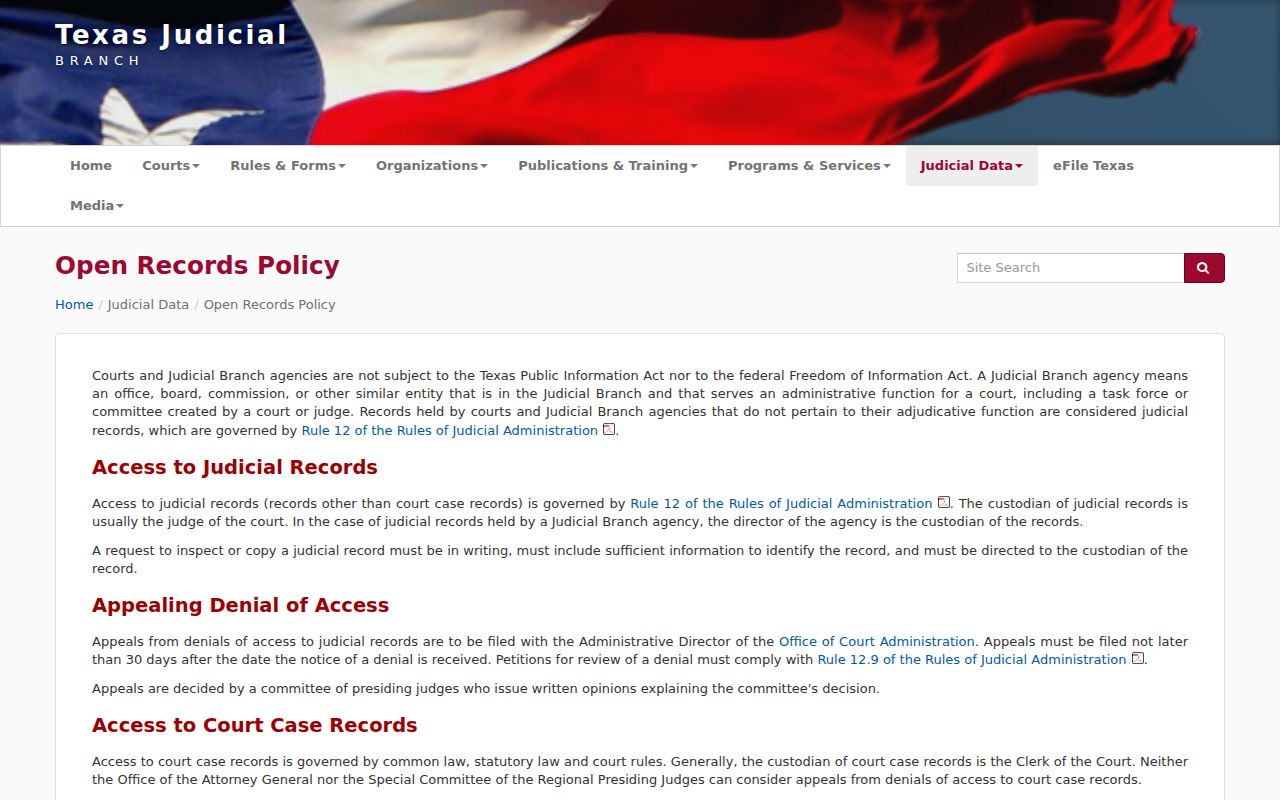
So a written Rule 12 request stays separate from any request for the criminal case docket itself.
When a Coleman Criminal Portal Fails
Portals go quiet for many reasons. iDocket's visible Coleman new-case dates run out in 2020. Re:SearchTX coverage depends on integration. A blank result can also come from spelling, a date range, court selection, a fresh filing, or a restriction. Save the exact search you ran, then contact the right clerk. Give the court level. Add the cause number if known, the full name as filed, the approximate period, and the case category. Ask whether the matter sits in another Coleman County court. Ask also whether a current setting exists. An arrest page, people-search vendor, or instant-record service is no stand-in for the court's docket.
Coleman Criminal Request Checklist
Put the basics in writing: the exact court, cause number if known, full case style, filing range, and the item you want. Request the docket history when you need the event sequence. Get the signed order when its terms matter. Take a certified copy when formal certification is required. Add a return address, and ask about the current charge and delivery method. No uniform turnaround applies to criminal copies across the board. If your question is about a setting, call the court rather than waiting on a records order. If it is about a judicial decision, the clerk cannot give legal advice or change the ruling. What the clerk can do is say which Coleman County file is held. The clerk can also explain how to request an available public copy.